
What does serverless mean? Somebody still runs the servers
Move a traffic slider to compare fixed capacity with managed functions. See what the provider handles, what you still own, and why serverless is not automatically free.
On this page
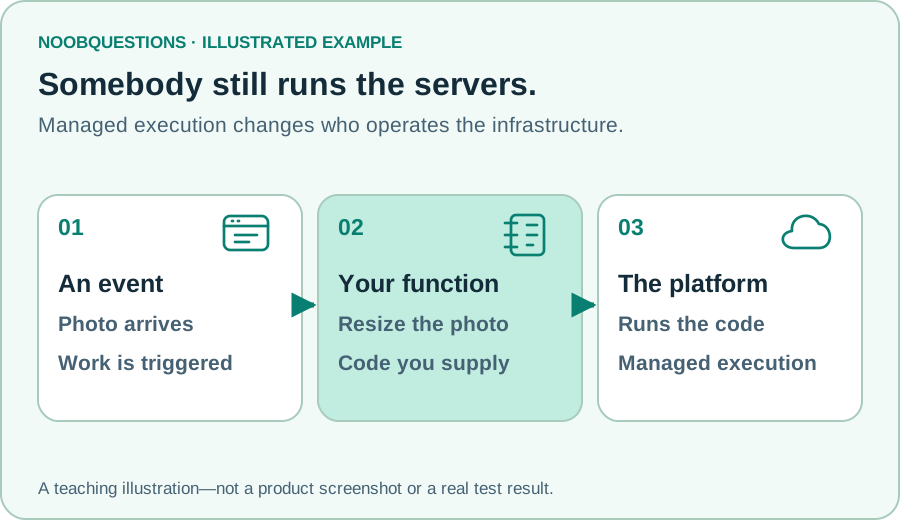
In a few minutes: Distinguish managing a computer from supplying a function, without pretending that servers disappear.
Serverless is about who manages what
Imagine a small service that resizes a photo when someone uploads it. One approach is to rent a computer, install the application, and keep that computer ready. Another is to supply a function that a managed platform runs when an event arrives.
In the second approach, computers still do the work. “Serverless” does not mean “without servers.” It describes moving more execution-infrastructure management to the provider. You focus on the function and its surrounding application rather than operating the underlying host yourself.
AWS Lambda’s documentation describes a managed way to run code without provisioning and managing servers. This guide uses a function-style mental model, not every product marketed as serverless.
Try it: quiet morning, busy afternoon
The fixed allocation below has four pretend job slots. Move the slider above four: some jobs must wait in this simplified picture. Then move it to zero: the allocation still exists, even though no jobs are active.
The managed side grows with each job in the illustration. Its instant growth is a teaching shortcut. Real systems have concurrency limits, queues, startup time, and failure handling. This is not a capacity forecast or a cloud bill calculator.
Learn by changing one thing
Who looks after the computers?
Move the traffic slider. Compare a fixed capacity you chose with capacity managed by a provider.
Instant one-slot-per-job scaling is a visual simplification, not a promise. Real services have limits, startup delays, queues, and pricing; zero jobs does not mean a zero total bill. Inputs stay on this page; no account, file, or network is changed.
You still have important jobs
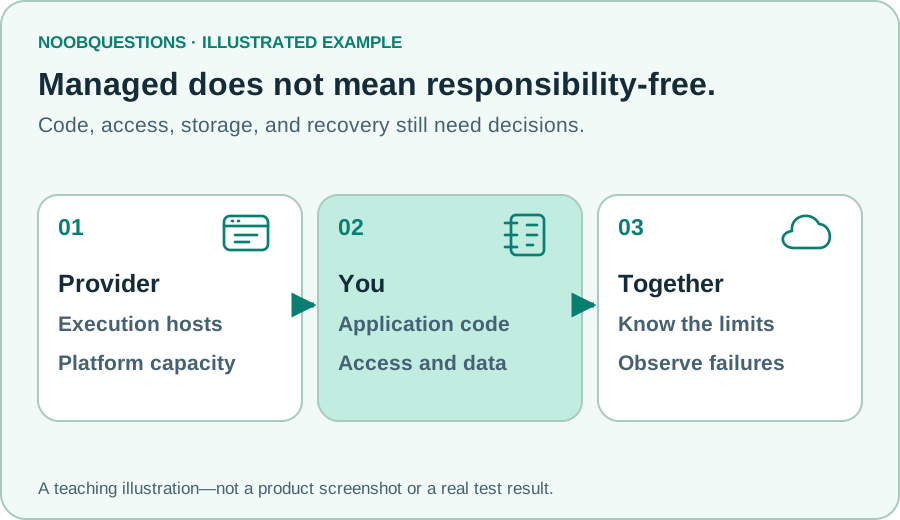
Someone must decide what the function is allowed to read, where it stores output, and how failures are reported. Those decisions do not vanish when a provider runs the computers.
For the photo service, ask: which upload starts the function, where is the resized image written, and what happens if processing runs twice? Keeping a record and making repeated work safe can matter more than the choice of hosting label.
A temporary execution environment is not a dependable permanent filing cabinet. Save durable information in an appropriate storage service. Reusing an environment can improve performance, but a function should not depend on its previous local state always being present.
When it helps—and when to pause
Event-driven, intermittent work can be a useful fit because you do not choose and run a host for every function yourself. But a continuously busy application may need a different cost and architecture comparison. Managed does not mean unlimited.
Zero pretend jobs in our slider does not guarantee a zero total bill. Storage, databases, logging, networking, minimum charges, or other application components can still cost money. Compare the actual services and pricing for the deployment you intend to use.
For a beginner project, first describe the task in one sentence: “When a photo arrives, make a smaller copy.” Then identify the input, output, permission, and failure case. If a static file can solve the problem, you may not need a function at all.
This site’s learning exercises run in your browser. Running a cloud function for every slider movement would add complexity without helping you understand this concept.
A quick check
Who is responsible for the function’s access permissions?
Pick an answer. You can try again.
Keep the labels in perspective
Serverless and microservices answer different questions. A microservice describes how an application is split into services; serverless concerns aspects of how code runs and infrastructure is managed. One does not require the other.
The older serverless and microservice architecture guide explores those labels. For the journey that gets a request to an application, start with DNS and website loading.
About this resource · sources, dates & scope
Attribution: noobquestions Editorial. Original publication: . Recorded revision: .
An original AI-assisted teaching lesson. Illustrations and models simplify the concept; they are not screenshots or proof of a deployed system.
AI-assisted · Original teaching scenarios; primary references checked October 2, 2026. Exercises are local models, not verified production deployments.
Community discussion
Comments
Ask a question or share a practical note. Comments publish immediately after verification and spam checks. Do not post personal or confidential information.
Loading comments…