
Why does MFA help when a password is stolen?
Give a pretend visitor the correct password and see whether they can sign in. Understand independent factors, recovery, and the limits of MFA.
On this page
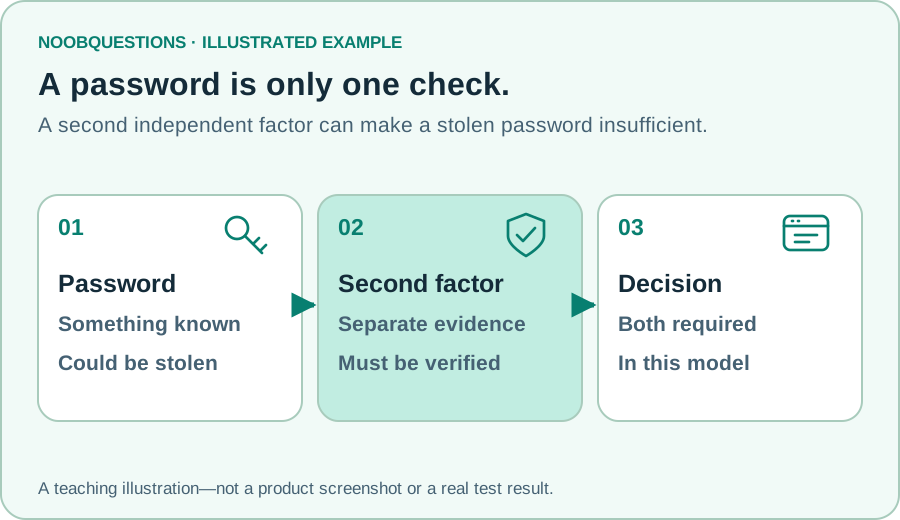
In a few minutes: See why a correct password alone can fail a second check—and why two passwords are not two independent factors.
The password is one kind of evidence
Imagine somebody learns the password for a shared notebook account. Under a password-only rule, that secret may be enough to sign in. Making the password longer does not undo the fact that this particular secret was stolen.
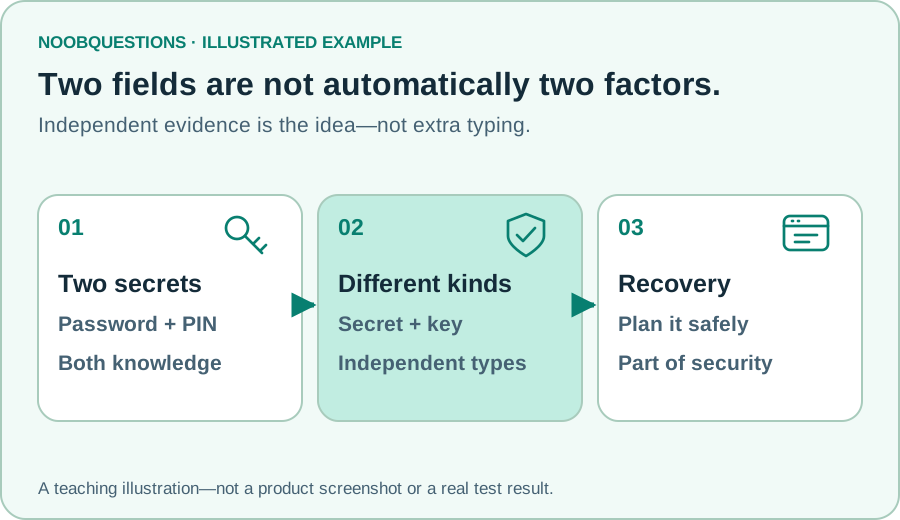
Multi-factor authentication, or MFA, asks for different kinds of evidence. A password is something you know. A security key or an authenticator can supply a possession-based factor. Two memorized secrets, such as a password and another PIN, are not automatically two independent factors.
The key idea is independence: an attacker who obtains one thing should not automatically obtain the other. OWASP’s MFA guidance explains the categories, implementation trade-offs, and attack patterns.
Try it: give the visitor a stolen password
Start with “correct password only.” The second check blocks the visitor in this model. Switch the rule to password only and the same evidence becomes enough. You changed the account rule, not the password.
Then restore the MFA rule and choose both kinds of evidence. The model allows that case. It cannot tell whether a real person was tricked into approving a request or whether their device is compromised.
Learn by changing one thing
Would a stolen password be enough?
Pretend somebody knows the password. Can they also satisfy the extra check?
This models two checks, not a login service. Real MFA can be attacked, and recovery or stolen sessions can bypass the picture. No codes or credentials are requested. Inputs stay on this page; no account, file, or network is changed.
A second check is not a magic shield
MFA can make a stolen password less useful, but different methods resist different attacks. Some codes can be relayed through a deceptive site; unexpected approval prompts can pressure someone into accepting a request they did not start.
Phishing-resistant options, such as properly implemented passkeys or security keys, bind authentication more closely to the intended service. They are not a reason to ignore device security or recovery settings. Availability and setup differ between services.
Our example deliberately ignores sessions. A real application may keep you signed in after authentication. An attacker who steals a valid session is not necessarily faced with the same two checks shown on the screen.
Prepare for your future self
Before relying on a new factor, understand the service’s supported recovery process. Losing a phone or security key should not mean improvising an unsafe workaround while locked out. Follow the service’s official instructions for backup methods or recovery codes.
Store recovery information securely and separately from an exposed password. Do not paste it into this site’s comments, a learning exercise, or a message from someone claiming to provide support. Recovery can be as sensitive as the normal sign-in method.
If you receive an approval request you did not initiate, do not approve it just to make the notification disappear. Return to the known official service and review its guidance. The exercise here never sends notifications or asks for a real one-time code.
For a workplace account, coordinate changes with the administrator. Enrolling a factor does not prove that every sign-in path, legacy client, or recovery route actually requires it.
A quick check
A password and another memorized PIN are both required. Is that necessarily MFA?
Pick an answer. You can try again.
After sign-in, what may you do?
Signing in answers a question about identity. It does not mean you should be able to edit every document or change other users’ access. Try the permissions notebook to separate authentication from authorization.
Remember the experiment’s narrow lesson: when the rule genuinely requires an independent second factor, knowing the password alone is insufficient. Whether a real account enforces that rule needs a real, authorized check.
About this resource · sources, dates & scope
Attribution: noobquestions Editorial. Original publication: . Recorded revision: .
An original AI-assisted teaching lesson. Illustrations and models simplify the concept; they are not screenshots or proof of a deployed system.
AI-assisted · Original teaching scenarios; primary references checked October 2, 2026. Exercises are local models, not verified production deployments.
Community discussion
Comments
Ask a question or share a practical note. Comments publish immediately after verification and spam checks. Do not post personal or confidential information.
Loading comments…